In Roberto Gonzales's chapter, "Contested Membership over Time," discusses the difficulty of being an undocumented immigrant in the United States. With new immigration policies such as DACA, the dichotomy of a good and bad undocumented immigrant is exclusionary and problematic.
When DACA and other immigration policies that would give many undocumented some legal status. However, many undocumented immigrants were excluded from these policies because there is a notion of a good and bad immigrant. Examples of a good undocumented immigrant subjects immigrants to the ideology of the American Dream. Such as a single mom providing for her children, a dreamer striving to go to an ivy league university, or making families complete. While the bad undocumented immigrant is seen as a criminal, gang member, and a felon. This dichotomy of a good or bad immigrants sets an idea that only a certain type of immigrant is deserving of legal status. This excludes many immigrants from being apart of the host country's social and political engagement. Thus, this sort of dichotomy also leads to racial profiling by police enforcement that can lead to deportation of undocumented immigrants.
Similarly, the dichotomy of a bad and good undocumented immigrant leads to an idea that some people are deserving of the safety and programs connected to citizenship. Undocumented immigrants don't have the ability to access healthcare and in many states can't obtain a driver's license without a social security number. These structures for daily life are limited for undocumented immigrants and if there status is exposed, they are threatened with deportation. The idea that only the good immigrants are deserving of legal status denies basic human rights and daily life structures to live in a host country. Especially when someone is characterized as an undocumented criminal should have equal access to basic healthcare and rights compared to a good immigrant.
A familiar dichotomy of a good vs. bad undocumented immigrant is also used for religion, specifically Islam. Post 9/11, the violence and negative stereotyping of Muslim men and women has increased. The dichotomy of a good and bad Muslim, I'd argue, is to continue the stereotype that all terrorists are of Muslim faith, but not all Muslims are terrorist. This dichotomy is used to defend Muslims, but instead continuously causes misconceptions of Muslim men and women, which still encourages violence towards the Muslim community. This dichotomy excludes the Muslim community from the religions that America will protect under the freedom of religion.
How can we address policies for undocumented immigrants without using the dichotomy of a good or bad person?
Wednesday, November 22, 2017
Wednesday, November 15, 2017
Jennifer Riera on "Forced to Choose: Beyond the Voluntary v. Forced Prostitution Dichotomy
In the chapter, “Forced to Choose: Beyond
the Voluntary v. Forced Prostitution Dichotomy,” the author, Jo Doezema, starts
off by providing a general overview of the history of prostitution in the West,
especially as it relates to feminist and abolitionist activism, but then
narrows in on the major split—voluntary v. forced—between the views on
prostitution that have allowed for the emergence of the voluntary/forced
dichotomous framework for viewing and analyzing prostitution. However, while
the way this dichotomy came to be is an interesting aspect of this paper and
the history of prostitution as a whole, my main focus for this blog post will
be on how exactly this relatively modern voluntary/forced dichotomous view of
prostitution has actually worked to reinforce existing systems and structures
that deny and abuse sex workers’ rights.
As was mentioned before, the aspect that
I will focus on for this blog post will be on how the voluntary/forced
dichotomous view on prostitution has done little to help protect or provide
rights for women in sex work. On the contrary, viewing prostitution under this
dichotomous framework actually does more harm than good, especially to those
who identify as “voluntary”, in the sense that it simultaneously reinforces
this virgin/whore dichotomy for “respectable” women and, thus, helps make it
easier to deny sex workers their basic human rights by virtue of their “role”
within a sexual assault or sex trafficking incident. As was explained in the
chapter, by viewing prostitution under the voluntary/forced lens, it often
forces people to view those who are “voluntary” prostitutes as “whores” who
brought it upon themselves by “volunteering” to work under such dangerous and
risky conditions, while those who were “forced” into this sex trafficking life
are victimized and, thus, viewed as the innocent “virgins” within this context.
As is normally the case, by using the
virgin/whore dichotomy, it essentially reduces a woman’s respectability and
worthiness down to which two categories they fall under, given their sexual
past (or lack thereof). Similarly, the voluntary/forced dichotomy for
prostitution acts along the same lines, in that if you’re a “voluntary” sex
worker (or whore), than you are not worthy of human rights or protections,
whereas the “forced” victim of sex trafficking (or the innocent virgin) is
worthy by virtue of falling on the “forced” category and having no prior
involvement with sex work or prostitution. I mention this last point because if
the “forced” victim of sex trafficking was a sex worker as well, then she will
be denied human rights and all the atrocities and violations committed to her
will be overlooked. Therefore, although it may seem as though the
voluntary/forced dichotomy makes sense at first glance, when you really think
about it, this dichotomy forces us to, essentially, decide if women are worthy
of rights and protections on the basis of their occupations as sex workers.
Because the author uses the virgin/whore
dichotomy to help clarify how the voluntary/forced dichotomy is troubling for
women in sex work, since where you fall dictates your worthiness and whether or
not you can qualify for protection and human rights, I found myself thinking
more broadly about the dichotomy of the virgin/whore and how it generally
affects and represses women and their lives. Put simply, the virgin/whore
dichotomy is a framework that forces individuals to categorize and discriminate
against women on the basis of their sexuality and sexual history. For example,
women can either be innocent, pure, non-sexualized “virgins”, or they can be
the complete opposite and, thus, be viewed as whores. in other words, there’s
no in-between for women—you can either be an innocent “virgin” or risk getting
labeled a “whore” since you failed at being a “virgin”. Not only is this
problematic for the obvious traditionally gendered and heteronormative
component to it, but also because it severely restricts women and their
movements and behaviors, especially as it relates to sex and sexuality.
Moreover, it negatively influences our perceptions of women’s roles (virgin or
whore) and severely limits our ideas about women can be and what they can
achieve that wont take into consideration what they do in private or
recreationally.
Now that we are on the subject of women
and their sexualities, we should look more into women’s reproductive health
(and reproductive justice) and how it’s constantly under threat by social
structures and dominant gendered ideologies, such as the framework of the
virgin/whore dichotomy.
https://grrrlbeat.files.wordpress.com/2011/09/lip-balm.jpg
Zubia Jahangir on Noah Berlatsky's "Human Trafficking Has Become a Meaningless Term"
Noah Berlatsky argues in “Human
Trafficking has become a meaningless term” that people associate women
trafficking with sex slavery as if they have a direct connection. The author
describes that human trafficking was known to be the practice of illegally
trading people locally or nationally for the purpose of sexual exploitation.
However, the author further explains that there are other forms of coerced
labor that are more common in human trafficking.
Berlatsky is accurate on arguing
that when it comes to human trafficking, people do focus more on the “coerced
sexual labor” part and ignore the fact that humans being trafficked are forced
to do all sorts of labor, like they have to work in factories, in houses and even
on farms without their own consent. The misconception of the term “trafficking”
is so widely spread that “New York’s Human Trafficking Intervention Courts are
used to handle basically anyone arrested for prostitution or related charges,
whether or not they have been coerced and whether or not they have come from
overseas.” The misinterpretation of one term could impact the laws and the
policies that could completely lead the court astray from the real crimes of
human trafficking.
The belief of making a direct
connection between women trafficking and sexual slavery also promotes the idea
of devaluing migrant women as they have degraded sexuality which would cause
the people to judge all the women who immigrated to their country as if they
migrated to sell or be forced into selling sex, and the worse part is that
these women would too think of themselves as devalued women when they had done
nothing as they have been perceived of doing so. This idea could also lead to
criminalize innocent migrant women like they have illegally emigrated from
their county to exchange sex for bread as if that is their business. Many of
the women are not even perceived as victims, but they are perceived as agents
who sell sex. The definitions and perceptions about women trafficking clearly
illustrate the widely spread sexism and racism in this world.
A worldwide known myth about
human trafficking is that “sex trafficking is the only form of human
trafficking.” People need to realize that human trafficking incorporates both
ideas of labor trafficking and sex trafficking which can drastically affect the
lives of the people being trafficked.
Why do people prefer judging other people based on the
popular beliefs rather than trying to find the truth and support the victims?
Melisa on "Human Trafficking" Has Become a Meaningless Term
In "Human Trafficking" Has Become a Meaningless Term, Noah Berlatsky explores the usage of the term "Human Trafficking" and how politicians and activists take advantage of the term's vagueness to appear to be defending victims of sexual exploitation. "Human trafficking" is usually interpreted as sexual slavery but it actually consists of many things like domestic, construction, and agriculture labor.
I thought that this issue was very interesting in the way that Berlatsky presents the phoniness of people who claim to be fighting the trafficking of people when in actuality this is a way to push for laws and policies that punish people who aren't being sexually exploited. Many times these laws have a bigger impact on minorities that engage in labor that doesn't align with the negative impression "human trafficking" brings to mind. Numerous people have been arrested on accounts of loitering, a crime that is not too serious, not selling children to sexual predators as it may seem.
The perception of "human trafficking" as sex slavery can misleading because it includes those who engage in consensual sex labor. Pro sex worker rights organizations try to communicate the true meaning of "human trafficking" and who it includes because it frequently isn't the victims of forced sexual labor as the term seems to be targeting. For example, runaway teenagers who are in difficult situations at home often do not have someone forcing them to partake sexual labor such as a pimp, most of the time they are trying to support themselves on their own after leaving the toxicity of their homes. They suffer from the laws against trafficking but do not have other ways of being able to fend for themselves.
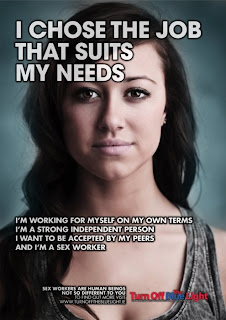
There are several organizations that fight for the rights of sex workers because they can be forgotten or shunned by society due to the idea that people who engage in sex work are sinful or deliquents. They are also humans and the legalization of sex business would help get these women the worker rights and protection from pimps they deserve. In the Women's March in Washington, the rights of sex workers were also included in the conversation for change and protection.

How can the language used to refer to sexually exploited women be changed to not also put other laborers in the same category and avoid misconceptions?
I thought that this issue was very interesting in the way that Berlatsky presents the phoniness of people who claim to be fighting the trafficking of people when in actuality this is a way to push for laws and policies that punish people who aren't being sexually exploited. Many times these laws have a bigger impact on minorities that engage in labor that doesn't align with the negative impression "human trafficking" brings to mind. Numerous people have been arrested on accounts of loitering, a crime that is not too serious, not selling children to sexual predators as it may seem.
The perception of "human trafficking" as sex slavery can misleading because it includes those who engage in consensual sex labor. Pro sex worker rights organizations try to communicate the true meaning of "human trafficking" and who it includes because it frequently isn't the victims of forced sexual labor as the term seems to be targeting. For example, runaway teenagers who are in difficult situations at home often do not have someone forcing them to partake sexual labor such as a pimp, most of the time they are trying to support themselves on their own after leaving the toxicity of their homes. They suffer from the laws against trafficking but do not have other ways of being able to fend for themselves.
There are several organizations that fight for the rights of sex workers because they can be forgotten or shunned by society due to the idea that people who engage in sex work are sinful or deliquents. They are also humans and the legalization of sex business would help get these women the worker rights and protection from pimps they deserve. In the Women's March in Washington, the rights of sex workers were also included in the conversation for change and protection.

How can the language used to refer to sexually exploited women be changed to not also put other laborers in the same category and avoid misconceptions?
Danijela Kaurin on Noah Berlatsky's “Human Trafficking Has Become a Meaningless Term”
Noah Berlatsky shows
people that there is no one solid definition to the term “human trafficking”. Many different people all over the world
define this term in various ways, thus allowing it to have hundreds of interpretations and cause many issues.
Berlatsky explains how important it is that everyone have a solid grasp of what trafficking is. All the different definitions cause wrong doings in the legal system as well as everyday conceptions of the term. It is stated that "the vagueness of the
definition allows or even encourages governments, organizations, and
researchers to claim that there are tens of millions of trafficking victims
worldwide on the basis of little more than hyperbolic
guesses." The fact that there are so many interpretations of this term causes a lot of issues within the legal system and the countries as well. This got me thinking on how poorly this affects all the women and men who experience such wrong misconceptions. They automatically get judged or portrayed as something that they may not consider themselves to be.
The term trafficking was originally meant to define the "migration of women from the collapsing Soviet Union to the United States." In addition to this definition, it is also known as when people are forced to move across and within borders for sexual purposes. Little is known that trafficking also occurs with consent. A majority of people think of "sex trafficking" as a thing that women are forced and battered to do; yes it is that in some ways, but with all different definitions of it, trafficking is also said to occur with consent.
Growing up in a world with many different views, I always thought of sex trafficking as a forceful migration of women by these bad people for sexual desires. Now as I learned more about it with this reading and class discussions, I came to know that there are so many different interpretations of it and trafficking isn't solely just "sex" trafficking. This website specifies and explains all the various forms of trafficking and different variations of meaning for trafficking.
Why can't one solid definition of this term be created so false conceptions as well as confusion amongst any be terminated?
Subscribe to:
Posts (Atom)